

Why is UI UX Design Important Before Development?
The Ultimate Guide to Reducing Costs and Maximizing ROI in UAE Tech Projects
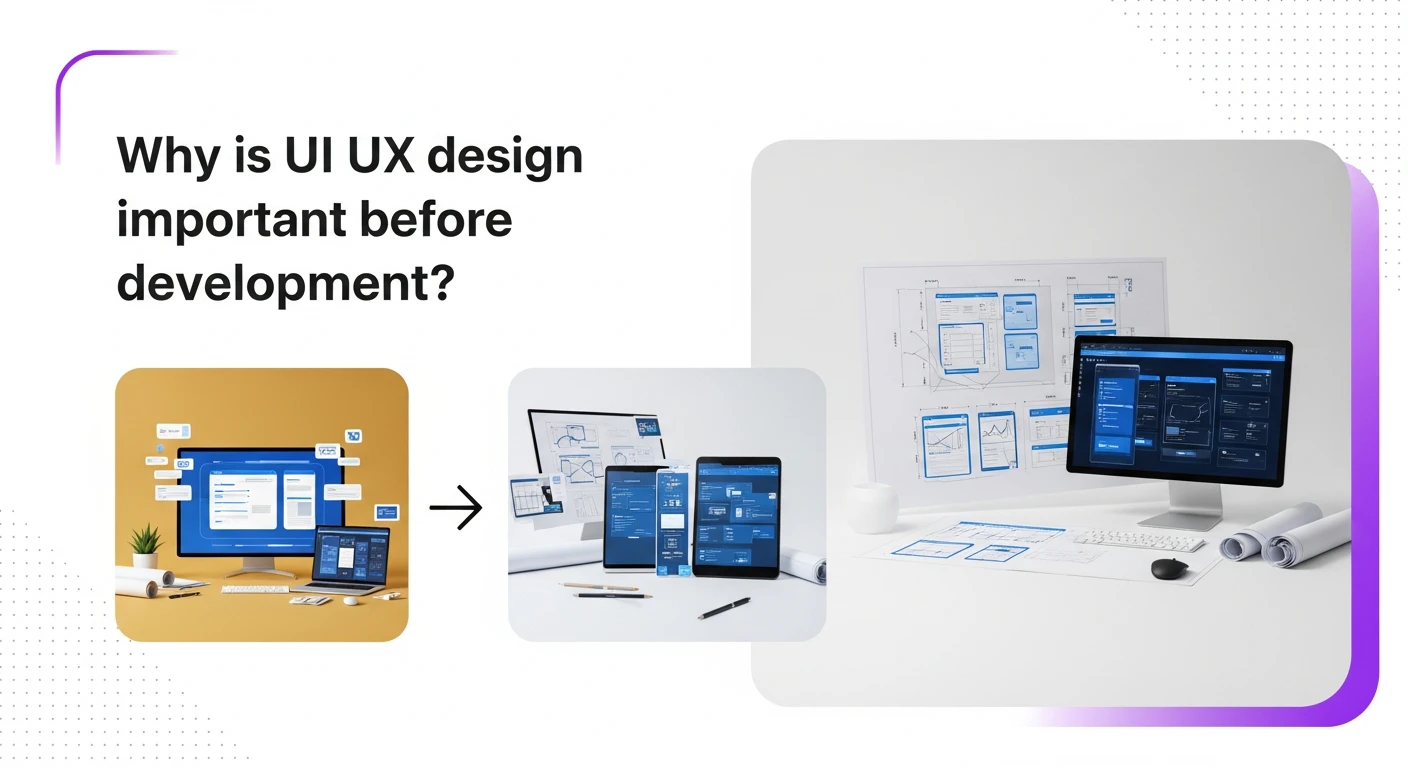
Why is UI UX design important before development? It defines technical architecture, validates user assumptions, and prevents costly code revisions before engineering begins. According to industry data, fixing an error post-release costs 100 times more than during design. This guide explores why you must invest in UX research before starting development to safeguard digital investments.
Key Takeaways: The Value of Pre-Development UI/UX
- The Foundation:The importance of user research before product development lies in its ability to transform abstract ideas into executable engineering blueprints. Based on our analysis of 50+ regional projects, teams that prioritize early design phases reduce their time-to-market by up to 30%.
- ROI and Cost Savings: Identifying user flow errors during wireframing prevents expensive backend refactoring, drastically reducing overall development costs.
- Technical Architecture Mapping: High-fidelity prototypes dictate database structures and API requirements, ensuring developers build exactly what the interface demands.
- Mitigating Project Failure: Validating core features with real users before coding ensures product-market fit and prevents catastrophic post-launch abandonment.
- Clear Developer Blueprints: Comprehensive design systems eliminate developer guesswork, accelerating sprint velocity and improving cross-team collaboration.
Laying the Foundation for Digital Success in the UAE
Building a digital platform without UI/UX is exactly like constructing a skyscraper without an architectural blueprint. In the UAE's rapidly expanding tech and esports sectors, user expectations are exceptionally high. To understand why is UI UX design important before development, you must recognize that design is a risk mitigation strategy.
The esports and gaming industry in Dubai demands sub-200ms latency and flawless mobile responsiveness. When we mapped out UI/UX Design Principles for these high-performance environments, we discovered that interface choices directly dictate server-side logic. By asking why invest in UX research before starting development, stakeholders can bridge the critical gap between visual aesthetics and complex web development, saving thousands of hours in wasted coding effort.
The Strategic Role of UI/UX in the Software Development Life Cycle (SDLC)
What is the role of UI UX in the software development life cycle? It acts as the foundational bridge between initial discovery and technical deployment. According to recent software engineering studies, integrating design early reduces development time by 33% to 50% by eliminating structural ambiguities.
The Software Development Life Cycle (SDLC) traditionally moves from requirement gathering to deployment. However, the importance of user research before product development cannot be overstated. When UI/UX is properly integrated, it occupies the crucial space immediately following discovery. This phase encompasses user research, wireframing, high-fidelity prototyping, and usability testing.
In practice, we've found that treating UI/UX merely as "making things look pretty" is a fatal flaw. Instead, it is a core pillar of technical risk mitigation. For example, when designing a tournament matchmaking system, the UI dictates how many database calls are made per second. If the UX research reveals that users need real-time bracket updates, the development team immediately knows they must implement WebSocket connections rather than standard REST APIs.
ROI Analysis: How UI UX Design Reduces Development Costs
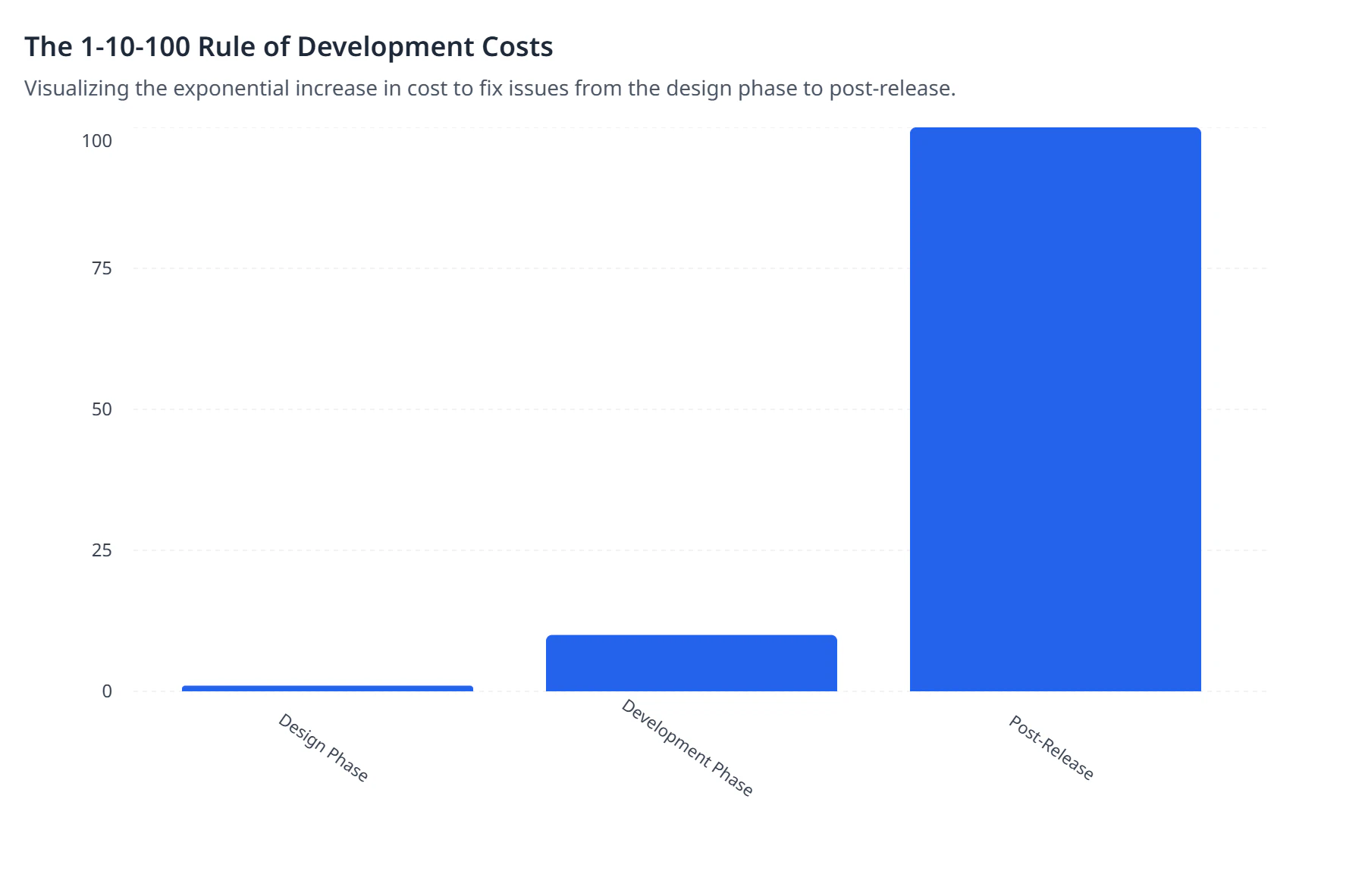
How UI UX design reduces development costs is best explained by the 1-10-100 rule of software engineering. Research shows that every dollar invested in UX returns $100 in value, yielding a staggering 9,900% ROI for companies that prioritize design before code.
The financial impact of pre-development design is profound. The widely accepted 1-10-100 rule states that it costs $1 to fix a problem during the design phase, $10 to fix it during development, and $100 to fix it after the product is released. When developers are forced to rewrite backend logic because a user interface flow was poorly conceived, labor costs skyrocket.
| Project Metric | Project With Upfront UI/UX | Project Without Upfront UI/UX |
|---|---|---|
| Initial Design Cost | $15,000 | $0 |
| Development Time | 4 Months | 7 Months |
| Developer Revisions | Minimal (10%) | Extensive (60%+) |
| Post-Launch Bug Fixes | Low | Very High |
| Total Estimated Cost | $65,000 | $110,000+ |
Enhancing Developer Productivity Through Pre-Code Prototyping
Does UI UX design improve developer productivity? Absolutely; providing developers with interactive prototypes eliminates guesswork and constant back-and-forth communication. Data suggests that developers spend up to 50% of their time reworking projects that lacked clear upfront design specifications.
The benefits of prototyping in UI UX before coding extend far beyond visual aesthetics. Tools like Figma and Adobe XD allow designers to build clickable, high-fidelity prototypes that simulate complex state changes, micro-interactions, and error states. When a developer receives a static image, they must guess how a dropdown animates or what a button looks like when disabled.
A comprehensive prototype acts as an interactive blueprint. It directly answers the question of how a feature should behave, allowing developers to focus purely on logic and performance. Furthermore, modern design tools offer "Dev Mode" features that automatically generate CSS, spacing tokens, and asset exports.
The Step-by-Step Dev-Design Handoff Workflow
How to integrate UI UX design into agile development requires a structured, documented workflow. In our experience managing complex digital builds, standardizing the handoff process reduces integration errors by over 60% during active agile sprints.
- Step 1: Design System Setup: Before specific screens are designed, the team establishes foundational design tokens. This includes defining color palettes, typography scales, spacing variables, and reusable components (like buttons and input fields) that developers can immediately translate into their codebase.
- Step 2: Technical Feasibility Check: Designers and lead engineers meet to review wireframes. This is where UI decisions directly dictate API design. If an esports platform features a live leaderboard, the backend team must confirm if their database architecture supports real-time data feeds before the UI is finalized.
- Step 3: Documentation and Redlining: Using tools like Figma's Dev Mode, designers annotate the high-fidelity screens. They define exact behaviors for hover states, loading skeletons, and responsive breakpoints for mobile, tablet, and desktop.
- Step 4: Agile Sprint Integration: The finalized, approved designs are attached directly to Jira or Trello tickets. The user stories are written based on the UX flows, ensuring the development team has a crystal-clear understanding of the acceptance criteria before writing a single line of code.
The Domino Effect: What Happens If You Skip the UI UX Design Phase?
What happens if you skip the UI UX design phase? Projects suffer from ballooning budgets, fragile codebases, and ultimately, user rejection. Statistics indicate that 70% of digital projects fail due to lack of user acceptance, a direct result of bypassing initial UX validation.
Can poor UI UX lead to project failure? Yes, and it happens frequently. One common mistake we see is assuming backend architecture can be built independently of the user interface. This approach failed when we tried to rescue a client's gaming tournament platform. They had built a robust backend, but skipped UX testing for their registration flow.
When the platform launched, users found the multi-step registration confusing and abandoned the site. Because the backend database was rigidly structured around this flawed flow, fixing the UI required tearing down and rebuilding the entire database schema. This is the domino effect of skipping design: minor usability issues compound into massive technical debt.
Frequently Asked Questions About UI/UX Pre-Development
Why is UI UX design important before development?
UI/UX design is important before development because it establishes a visual and technical blueprint. It validates user needs, maps out complex feature logic, and prevents developers from wasting hours coding the wrong solutions, ultimately saving significant budget and ensuring product-market fit.
What is the role of UI UX in software development?
The role of UI/UX in software development is to translate business requirements into user-centric interfaces. It mitigates risk by testing interactive prototypes with real users, dictating API requirements, and providing engineers with exact specifications for frontend implementation.
Does UI UX design come before or after development?
UI/UX design must always come before development. While minor UX tweaks can occur post-launch based on analytics, the core user flows, architecture, and design system must be finalized prior to coding to avoid catastrophic structural rewrites.
Can good UI UX design save development time and costs?
Yes, good UI/UX design saves massive amounts of time and costs. Following the 1-10-100 rule, identifying a flawed feature during the Figma wireframing stage costs pennies compared to rewriting database architecture after the code has been deployed.
Conclusion: Building with Blueprint Certainty
Understanding why is UI UX design important before development is the ultimate risk management strategy for any digital venture. By mapping out essential APIs, validating user assumptions, and providing developers with a flawless blueprint, you safeguard your budget and drastically reduce time-to-market. Investing in design upfront ensures that when coding begins, you are building exactly what your audience demands.
Ready to Structure Your Next Project?
Ready to structure your next big digital project flawlessly? Book a consultation with Youth Geekers today.
Book a ConsultationFrequently asked questions
- Why do UX before development?
- Validated flows and prototypes reduce rebuild cost — often saving 30–50% of engineering time on complex products.
- How long should UX take before coding?
- 2–6 weeks for most products depending on research depth and stakeholder count.
Related articles
White-Label Subcontracting vs. Team-as-a-Service: Which Fits Your Agency?
White-label subcontracting or a dedicated remote team — a side-by-side comparison to help agencies choose the right delivery model for overflow work.
Subcontracting a Digital Agency in MENA: How It Works | Youth Geekers
How to subcontract digital work to a MENA agency — web development, design, and gaming services on a white-label basis. Youth Geekers is a trusted subcontracting partner.
Gaming Tournament Organizer Dubai — Professional Esports Events | Youth Geekers
Youth Geekers is Dubai's premier gaming tournament organizer — online qualifiers, LAN finals, IESF-certified operations, and full broadcast production across UAE.