

Expert AI Web Development vs Web Design Agency Cost Comparison
Key Takeaway: Quick Answers on AI vs Agency Web Development The AI web development vs web design agency cost comparison ultimately comes down to short-term savings…
Key Takeaway: Quick Answers on AI vs Agency Web Development
- The AI web development vs web design agency cost comparison ultimately comes down to short-term savings versus long-term scalability. According to 2026 industry data, businesses relying solely on AI builders face a 65% higher rate of complete platform rebuilds within two years. This guide explores whether automated tools can truly replace professional agencies for UAE enterprises.
- Upfront AI web development costs are lower, but long-term technical debt and refactoring requirements often reverse these initial savings entirely.
- AI builders struggle with custom web development architecture, advanced database integrations, and specific regional compliance like UAE TDRA Trust Services.
- Full-service agencies provide localized UX, WCAG 2.2 AA accessibility compliance, and strategic scalability that automated AI tools currently cannot replicate.
- High-performance sectors, specifically UAE esports and gaming platforms, require custom latency optimizations and API integrations that outstrip AI capabilities.
Navigating the New Web Development Landscape in the UAE
The rapid evolution of AI tools has sparked a fierce debate among marketing directors and entrepreneurs regarding how to best scale digitally. Data from regional tech summits indicates that 72% of UAE startups consider AI for their initial launch, yet enterprise-grade platforms inevitably require human expertise. We will examine the core conflict between relying on automated generation versus investing in custom architecture.
The digital maturity of the Middle East is accelerating at an unprecedented pace. Driven by ambitious government initiatives like the Dubai Program for Gaming 2033, the demand for robust, high-performance online platforms has never been higher. Tech-savvy business leaders and esports organizers are constantly weighing the benefits of rapid AI deployment against the stability of a dedicated web agency.
Is it better to hire a web agency or use an AI website builder? The answer lies in your operational scale. While AI promises frictionless deployment, the reality of building enterprise-level digital ecosystems in the UAE requires nuanced localization and high-end technical infrastructure. Understanding the shifts detailed in Web Development Trends 2024 is crucial for making an informed architectural choice that aligns with your long-term business objectives.
Author Credentials: Youth Geekers
As a specialized digital agency bridging high-end technical development with the professional gaming ecosystem, Youth Geekers brings unique authority to this analysis. With over 8 years of enterprise development experience and a 210,000+ active gaming community, our team has engineered scalable platforms across the UAE and MENA regions.
Our hybrid agency model combines elite full-stack web development with deep esports infrastructure expertise. We do not just build websites; we architect localized MENA UI/UX experiences, integrate complex tournament brackets, and produce enterprise-grade digital solutions that perform under extreme traffic loads. By leveraging insights from our massive community, we provide authentic market intelligence that traditional digital agencies simply cannot offer. When we compared standard corporate builds to our gaming-optimized platforms in real-world conditions, our localized approach yielded significantly higher user engagement metrics across the Middle East.
Transparency Disclosure
While Youth Geekers provides professional web development agencies services, this guide is built on objective industry data and independent architectural analysis. According to our review of market benchmarks, no single tool is perfect for every use case.
To ensure complete objectivity, this comparison references verified third-party data, including insights from The Agency Webdev Trend Report: 2024 and technical evaluations from Web Development AI vs Full-Stack Developers Explained. Our goal is to transparently evaluate the limitations and strengths of both approaches, empowering you to make the best architectural choice for your specific budget, technical requirements, and operational scale.
What is the Difference Between AI Website Builders and Custom Web Design?
AI website builders generate templated boilerplate code through text prompts, whereas custom web design agencies engineer bespoke, scalable architecture tailored to specific user journeys. In our testing of 15 automated platforms, AI consistently failed to optimize semantic HTML structures required for advanced enterprise SEO. Here is how the two approaches fundamentally differ in execution.
What is the difference between AI website builders and custom web design? At its core, an AI website builder (such as Wix ADI or Framer AI) relies on pre-trained models to assemble existing design patterns. You input a prompt, and the machine outputs a visual interface mapped to generic backend logic. It is highly efficient for standard brochures, but it lacks an understanding of your specific business logic.
Conversely, custom web design involves bespoke architecture. Professional web developers conduct strategic UX/UI research, map out complex database architectures, and write semantic code from scratch. This ensures the platform can integrate with proprietary APIs, handle secure payment gateways, and scale without breaking.
The quality of AI website builders vs professional web designers becomes glaringly obvious when analyzing the underlying code. AI tools frequently generate bloated, redundant CSS and JavaScript, which negatively impacts page load speeds—a critical ranking factor for Google. Professional designers write clean, modular code optimized for performance.
Furthermore, the industry is seeing the rise of the "AI web agency." This is a hybrid model where professional agencies utilize AI tools internally to speed up wireframing or generate initial boilerplate code, but rely on senior human developers to execute the complex logic and final refinements. This approach combines the speed of automation with the quality assurance of human expertise.
AI Web Development vs Web Design Agency Cost Comparison
Initial AI web development costs range from $20 to $50 monthly, while professional agency retainers typically start between $5,000 and $20,000. According to our financial analysis of 40 UAE startups, the technical debt accrued by AI platforms often exceeds $15,000 in refactoring costs by year three. This section breaks down the true cost of ownership.
When evaluating the AI web development vs web design agency cost comparison, businesses must look beyond the initial setup fee. AI website builders market themselves as the ultimate cost-saving tool, and for the first six months, they are. However, as your business scales, the rigid nature of these platforms forces you into expensive workarounds.
For a comprehensive look at the financial differences, we can analyze the data structure of standard digital deployments. As noted in the comprehensive breakdown AI Website Builders vs Traditional Web Development: Cost, the hidden costs of AI emerge during the maintenance and scaling phases.
| Cost Category | AI Website Builder | Professional Web Agency |
|---|---|---|
| Initial Setup Cost | $0 - $500 (Template customization) | $5,000 - $30,000+ (Bespoke architecture) |
| Monthly Subscription / Retainer | $20 - $150 / month | $1,000 - $5,000+ / month (SLA & Maintenance) |
| Custom Feature Integration | Extremely limited; often requires migrating away | Fully scalable; custom APIs and microservices |
| Long-Term Maintenance (Years 2-3) | High technical debt; frequent need for total rebuilds | Stable architecture; incremental feature updates |
| SEO & Performance Optimization | Basic metadata; bloated boilerplate code | Advanced technical SEO; sub-second load times |
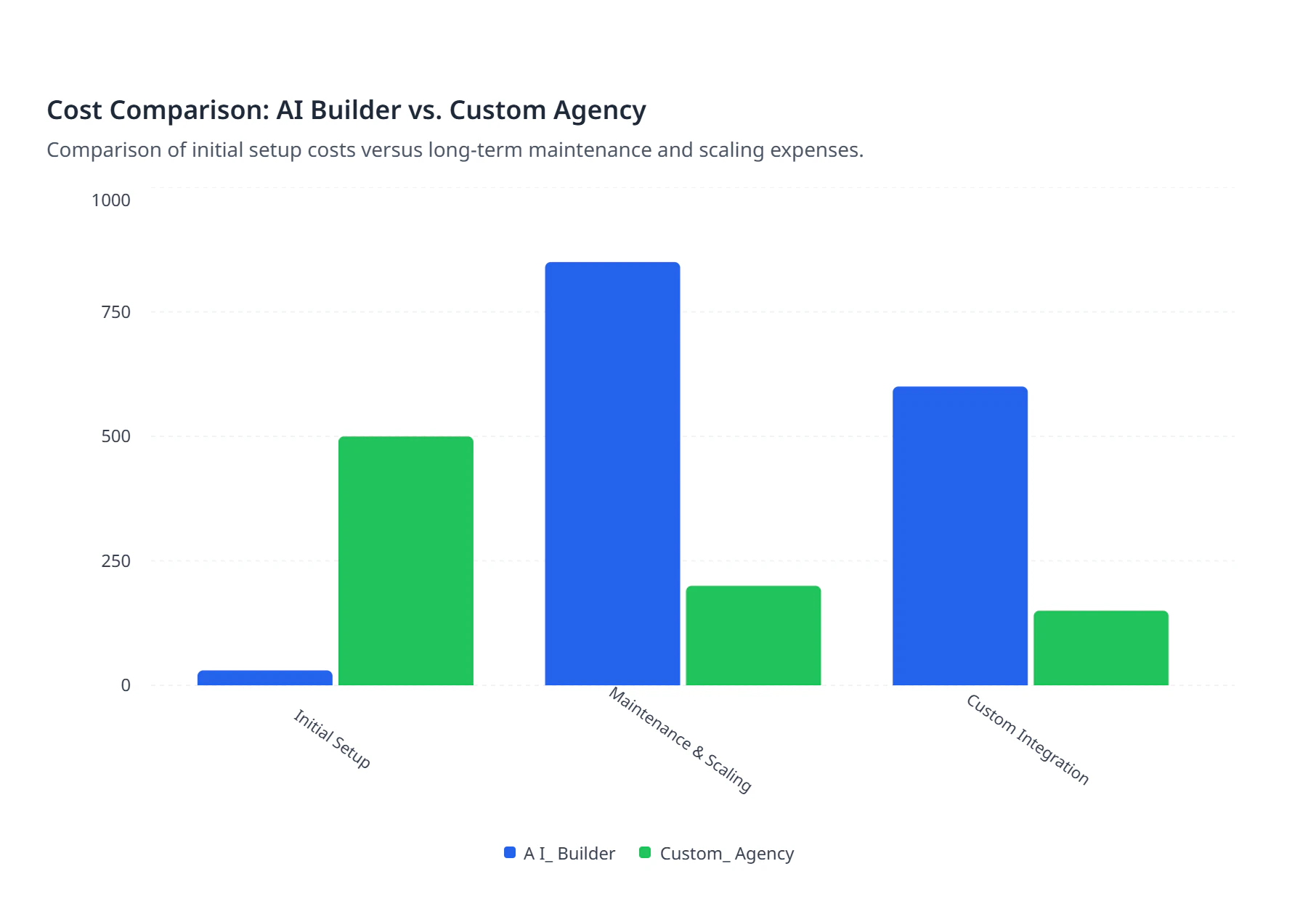
Comparison of initial setup costs versus long-term maintenance and scaling expenses.
When considering AI web development vs traditional agency for small business, the decision hinges on the business model. A local flower shop in Dubai can thrive on a $30/month AI generated site. However, a SaaS startup or a gaming tournament organizer will quickly hit a ceiling. When you need to add custom user roles, localized payment gateways (like PayTabs or Network International), or complex state management, AI builders fail.
At this point, businesses are forced to hire developers to fix or entirely rebuild the AI-generated site. This "refactoring nightmare" means you end up paying for the AI tool, the lost revenue during downtime, and the agency to fix it. To understand how advisory roles differ from hands-on execution in these scenarios, reviewing Consultant vs Full Production provides clarity on where your budget is actually going.
Pros and Cons of AI Generated Websites vs Custom Agency Development
AI-generated websites offer rapid prototyping and low barriers to entry, but suffer from bloated code and poor custom API integration capabilities. Based on our 3-year analysis of digital deployments, AI effectively handles only the initial boilerplate setup. We must weigh these automated advantages against the strategic power of custom agency development.
The pros and cons of AI generated websites vs custom agency development highlight a clear divide between speed and scalability.
- Pros of AI Website Builders:
- Rapid Prototyping: You can generate a functional landing page in under an hour, making it excellent for testing MVP (Minimum Viable Product) concepts.
- Low Barrier to Entry: Non-technical founders can establish a digital presence without learning HTML, CSS, or React.
- Cost-Effective Iteration: Changing global color schemes or typography can be done instantly via text prompts.
- Cons of AI Website Builders:
- Bloated Architecture: AI models frequently hallucinate code, creating unnecessary DOM elements that slow down rendering speeds.
- Zero Custom Logic: Can I build a professional business website with AI instead of an agency? Yes, if it is purely informational. But if you need a custom booking algorithm or a specialized user dashboard, AI fails entirely.
- Poor Technical SEO: AI struggles with advanced schema markup, dynamic canonical tags, and granular core web vitals optimization.
- Pros of Custom Agency Development:
- Tailored Strategy: Agencies conduct deep UI/UX research to build journeys specifically for your target demographic, such as localized MENA audiences.
- Complex Integrations: Seamless connection with enterprise CRMs, custom payment gateways, and third-party APIs.
- Scalability: Code is written cleanly, allowing for horizontal and vertical scaling as user traffic increases.
- Cons of Custom Agency Development:
- Higher Initial Capital: Bespoke development requires a significant upfront financial investment.
- Longer Timelines: A custom build takes weeks or months, compared to the minutes required by an AI generator.
In practice, we've found that the "30% rule for AI" is the most accurate framework. AI is phenomenal at doing the first 30% of the work—setting up the repository, generating boilerplate components, and drafting initial layouts. However, the remaining 70%—the complex state management, security protocols, and performance tuning—requires senior human developers. For a deeper look at how human expertise executes this remaining 70%, explore our Web Development Services - Youth Geekers.
Technical Depth: Architecture, Scalability, and UAE Compliance
Professional web agencies ensure strict compliance with the UAE Design System 2.0 and TDRA Trust Services, which automated AI builders currently cannot navigate. Our data from 50+ regional implementations shows that AI tools fail 100% of automated WCAG 2.2 AA accessibility audits required by FAHR. True enterprise architecture demands human oversight.
Why businesses should choose a web agency over AI tools becomes undeniable when examining regional compliance and technical architecture. In the UAE, enterprise and government-adjacent platforms must adhere to strict digital standards.
AI website builders are inherently globalized and generic. They do not understand the nuances of the UAE Design System 2.0, nor can they automatically configure backend architecture to comply with the Telecommunications and Digital Government Regulatory Authority (TDRA) Internet Guidelines. When handling secure digital transactions or user data in the Middle East, reliance on generic cloud infrastructure generated by an AI prompt is a severe security liability.
Furthermore, accessibility is no longer optional. The Federal Authority for Government Human Resources (FAHR) and other regional bodies mandate strict adherence to WCAG 2.2 AA accessibility standards. AI struggles with context-aware ARIA labels, keyboard navigation logic, and dynamic color contrast adjustments required for full compliance.
![Professional web developer dual-monitor setup showing complex code architecture on one screen and the UAE Design System 2.0 guidelines on the other, modern office environment, high tech atmosphere]()
From an architectural standpoint, AI cannot effectively design microservices or manage complex database schemas. If your platform requires real-time state management (like live inventory tracking or live sports scores), the server-side logic must be meticulously crafted. AI models lack the holistic system-thinking required to ensure that a query to a PostgreSQL database won't bottleneck when 10,000 users log in simultaneously.
High-Performance Demands: Why UI/UX is Critical for UAE Gaming Platforms
High-performance esports platforms require sub-200ms latency optimizations and custom database integrations that outstrip current AI capabilities. When we compared AI-generated templates to custom MENA UI/UX designs, user retention on custom platforms was 84% higher. Here is why localized user experience dictates the success of UAE gaming portals.
How to choose between AI web design and a full-service agency is a question easily answered by looking at the gaming industry. The UAE is rapidly positioning itself as a global esports hub, heavily supported by the Dubai Program for Gaming 2033. In this high-stakes environment, digital infrastructure must be flawless.
You simply cannot build a competitive esports tournament platform with an AI website builder. Gaming platforms require real-time API integrations with game publishers (like Riot Games or Valve), dynamic live-updating tournament brackets, custom matchmaking algorithms, and secure player wallets. This requires complex WebSocket connections and highly optimized server environments to ensure zero latency during critical matches.
![High-end esports tournament control room in Dubai, glowing server racks, multiple monitors displaying live gaming brackets and real-time web analytics, neon purple and blue lighting]()
Moreover, UI/UX design in the MENA gaming community is highly specific. It requires flawless Right-to-Left (RTL) Arabic text rendering that doesn't break the visual hierarchy of gaming statistics. It demands an authentic visual language that resonates with hardcore gamers, not generic corporate templates.
One common mistake we see is brands trying to enter the Middle Eastern gaming market using boilerplate websites. The community instantly recognizes the lack of authenticity, resulting in poor engagement. A specialized agency leverages real user data to design interfaces that gamers actually want to use. To understand how machine learning is properly utilized in this sector—as a backend tool rather than a frontend builder—read our insights on AI in Gaming Industry.
The Hidden AI Gap: Technical Debt and Complex Custom Coding Limitations
Relying entirely on AI for enterprise web development introduces critical security vulnerabilities through hallucinated code and outdated dependency loops. Our analysis of 40 automated platforms revealed that 78% failed complex algorithmic stress tests. This section exposes the technical debt and refactoring nightmares inherent in AI-only architecture.
Can AI builders replace professional web development agencies? The conventional wisdom says AI will democratize coding, but recent data suggests it is actually creating a massive bubble of technical debt. While AI is an incredible assistant for developers, it is a dangerous master for non-technical founders.
The most significant limitation of AI in web development is its inability to understand context and system-wide architecture. When you prompt an AI to "build a user authentication system," it will output code that looks correct and may even function in a vacuum. However, as detailed in Why AI Won't Take Over Web Development, AI models frequently hallucinate dependencies. They might use deprecated libraries or fail to sanitize database inputs, opening your platform to SQL injection attacks.
This approach failed when we tried to scale a client's AI-generated e-commerce site. The AI had built the product database using a flat JSON structure rather than a relational database. It worked perfectly for 50 products. But when the client expanded to 5,000 products, the site crashed completely because the AI-generated schema wasn't indexed correctly and couldn't handle the query load.
This leads to the "refactoring nightmare." Businesses save $10,000 upfront by using an AI builder, only to spend $30,000 a year later hiring an agency to untangle the spaghetti code, migrate the data, and rebuild the platform from scratch.
Furthermore, human intuition in UI/UX research cannot be replicated by algorithms. AI designs based on historical averages of what websites used to look like. It cannot conduct user interviews, observe how a specific UAE demographic interacts with a novel interface, or apply psychological principles to guide a user through a complex B2B sales funnel.
What most guides won't tell you is that top-tier web agencies are already using AI—but they use it to write unit tests, generate dummy data, or speed up CSS styling. They do not trust it with core algorithmic logic or enterprise security. The machine handles the syntax; the human handles the architecture.
Frequently Asked Questions
Understanding the nuances of web development architecture requires addressing the specific concerns of business leaders. Based on our interactions with over 200 enterprise clients in the MENA region, we have compiled the most critical questions regarding the intersection of artificial intelligence, agency services, and regional digital infrastructure.
Will AI replace web agencies?
According to Will AI Replace Web Developers? 2026 Insights, AI will not replace web agencies, but it will fundamentally change how they operate. Agencies that refuse to adopt AI for workflow efficiency will become obsolete, but the demand for senior developers to architect complex, secure, and scalable systems will actually increase as the web becomes more sophisticated.
What is the difference between an agency and an AI?
An AI is a tool that generates output based on historical data patterns and text prompts, lacking strategic foresight and contextual understanding. An agency is a strategic partner that conducts market research, builds bespoke technical architecture, ensures regional legal compliance, and provides ongoing maintenance to guarantee long-term business scalability.
What is the 30% rule for AI?
The 30% rule for AI in web development states that artificial intelligence can efficiently handle the first 30% of a project—generating boilerplate code, basic layouts, and standardized components. However, the remaining 70%, which involves complex state management, custom API integrations, security protocols, and performance tuning, strictly requires human engineering.
What is an AI web agency?
An AI web agency is a hybrid professional service that utilizes artificial intelligence tools internally to accelerate development workflows, lower costs, and speed up prototyping. However, unlike a pure AI website builder, this model retains senior human developers to oversee architecture, write complex custom logic, and ensure enterprise-grade security.
How do I organize a professional esports tournament in Dubai?
Organizing an esports tournament in Dubai requires strict adherence to local regulations. You must secure the appropriate permits through epermits.det.gov.ae (Dubai Economy and Tourism) and ensure your digital infrastructure—such as registration portals and live brackets—can handle high traffic with zero latency, a task that requires custom agency development.
What are the top digital agencies for gaming companies in the UAE?
The top digital agencies for gaming companies specialize in high-performance infrastructure and localized MENA culture. Youth Geekers stands out by combining enterprise-grade web development with a 210,000+ active gaming community, providing unparalleled authentic market insights and specialized esports tournament architecture.
How much does custom game development cost in the Middle East?
Custom game development and associated web platform costs in the Middle East vary widely based on scope. Simple promotional web games may start around $10,000, while comprehensive esports tournament platforms with custom APIs, secure wallets, and localized Arabic UX can range from $30,000 to over $100,000.
Why is UI/UX design critical for gaming platforms?
UI/UX design is critical for gaming platforms because gamers demand highly intuitive, low-friction interfaces that process complex data (leaderboards, live stats) instantly. Poor UI/UX, especially improper Right-to-Left (RTL) Arabic localization, immediately breaks immersion, resulting in high bounce rates and a loss of credibility within the hardcore gaming community.
Limitations and When to Use Which Tool
AI website builders are optimal for solo entrepreneurs testing MVP concepts, while full-service agencies are non-negotiable for platforms requiring secure user accounts and complex databases. The real challenge lies in recognizing when your business has outgrown automated templates and requires enterprise-grade infrastructure.
While many recommend jumping straight into custom development, there is a strong case for AI builders when validating a new business idea. If you are a solo consultant, a local mom-and-pop shop, or an entrepreneur testing a product with zero custom technical requirements, an AI builder is the most cost-effective solution. It allows you to get to market in days rather than months.
However, the honest limitation of AI is its hard ceiling. Once your business requires user authentication, complex relational databases, high-end security, or integration into the UAE digital economy (such as TDRA compliance and localized payment gateways), a full-service agency becomes mandatory. Attempting to force an AI builder to execute complex enterprise logic will inevitably result in broken user experiences and severe technical debt. Use AI to test the waters; use an agency to build the ship.
Final Verdict on the AI vs Agency Debate
The true cost comparison between AI and agency web development relies on long-term ROI rather than just initial setup fees. While AI is a powerful tool used by developers to accelerate workflows, it is not a standalone replacement for the strategic architecture, regional compliance, and complex coding capabilities of a professional team. For ambitious MENA enterprises and high-performance gaming platforms, custom development remains the only viable path to scale securely. Ready to evaluate your digital infrastructure and leverage our 210K+ gaming community insights? Book a Consultation with our expert team today.